For owners, administrators and bookkeepers
A school you can see.
Teaching, schedule and money in one system - so the month closes on what actually happened, and the courses stay with the school when a teacher does not.
We are launching by invitation. A demo runs on your courses, your prices and your currency.
Four subscriptions, four sets of numbers
You are already paying for this. Four times.
Most schools run on a whiteboard, a course tool, a scheduler and a spreadsheet the bookkeeper trusts more than any of them. Nothing reconciles the four, which is why the school's real numbers live in somebody's head.
One system does not just cost less than four. It removes the work of making four agree - which was never on an invoice, and was always the expensive part.
The owner's problem is not teaching
Three things a school owner cannot see.
You already know how to run a lesson. What costs a school money is what happens between the lessons, where nobody is looking.
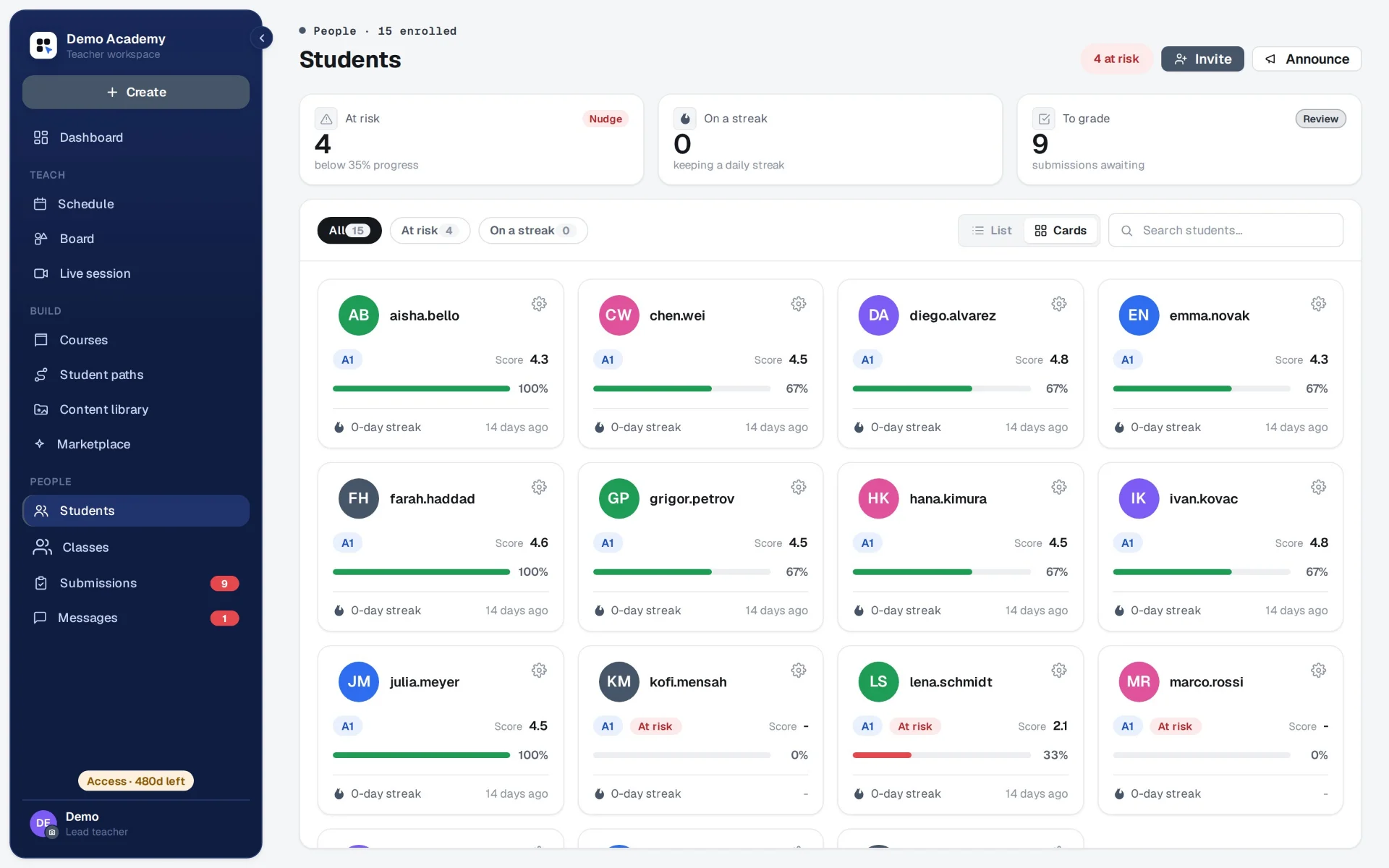
Who is about to leave
A student leaves weeks after they stopped doing the work - the cancellation is the last event, not the first. The system holds the earlier ones: submissions that stopped, a streak that broke, homework returned late, a lesson missed.
So a teacher's student list is ordered by who needs attention, not alphabetically, and the person who could still save the enrolment finds out while it is still savable.
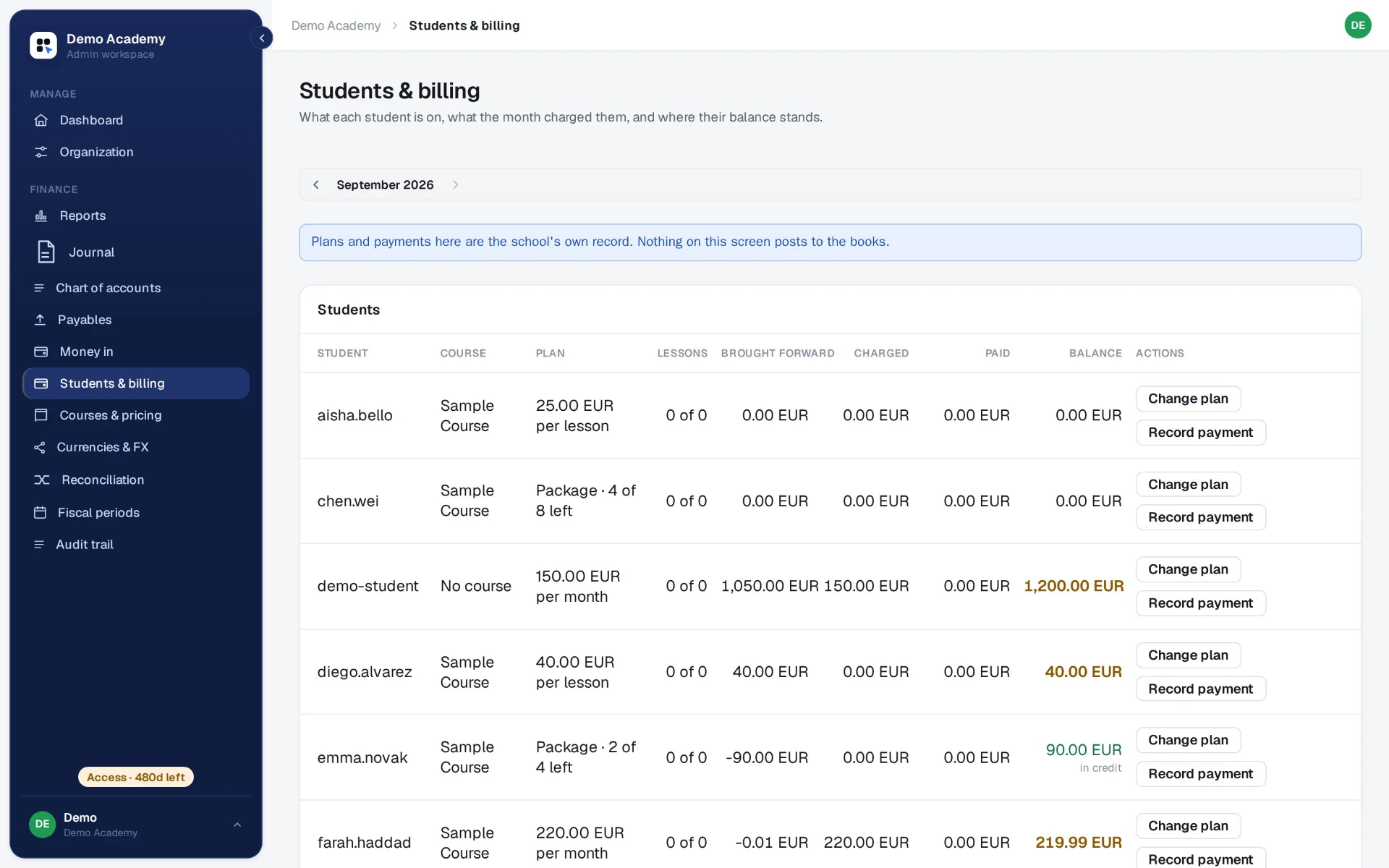
What is actually unpaid
A student's account is read one month at a time in the school's own timezone, and each month is an account rather than a snapshot: what was brought forward, what was charged, what arrived, what is still owed. Nothing is lost at the boundary of a month.
Access follows the paid period, so the consequence of an unpaid month is a workspace that stops - not an administrator writing a third reminder.
What was actually taught
Not what the plan said. The board holds the lesson that was published, the submissions hold what students handed in, the grading holds what came back, and the schedule holds who was in the room.
A parent asks what their child did in October, or a teacher leaves mid-term, and the answer is in the school rather than in someone's private folder.
For the person who closes the month
The bookkeeping is real bookkeeping.
Not a revenue chart. A double-entry ledger with a chart of accounts, immutable postings, period close and bank reconciliation - so your bookkeeper does not need a second tool, and your administrator does not have to become a bookkeeper.
The ledger
- Chart of accounts
- Manual entries, balanced
- Reversal, never edit-in-place
- Accounting periods, closed and reopened deliberately
The statements
- Trial balance
- Balance sheet
- Profit and loss
- Cash flow
- General ledger and journal
The month's work
- Aging of what is owed
- Tax summary
- Currency revaluation
- Bank reconciliation from an imported statement
- Exports for whoever files
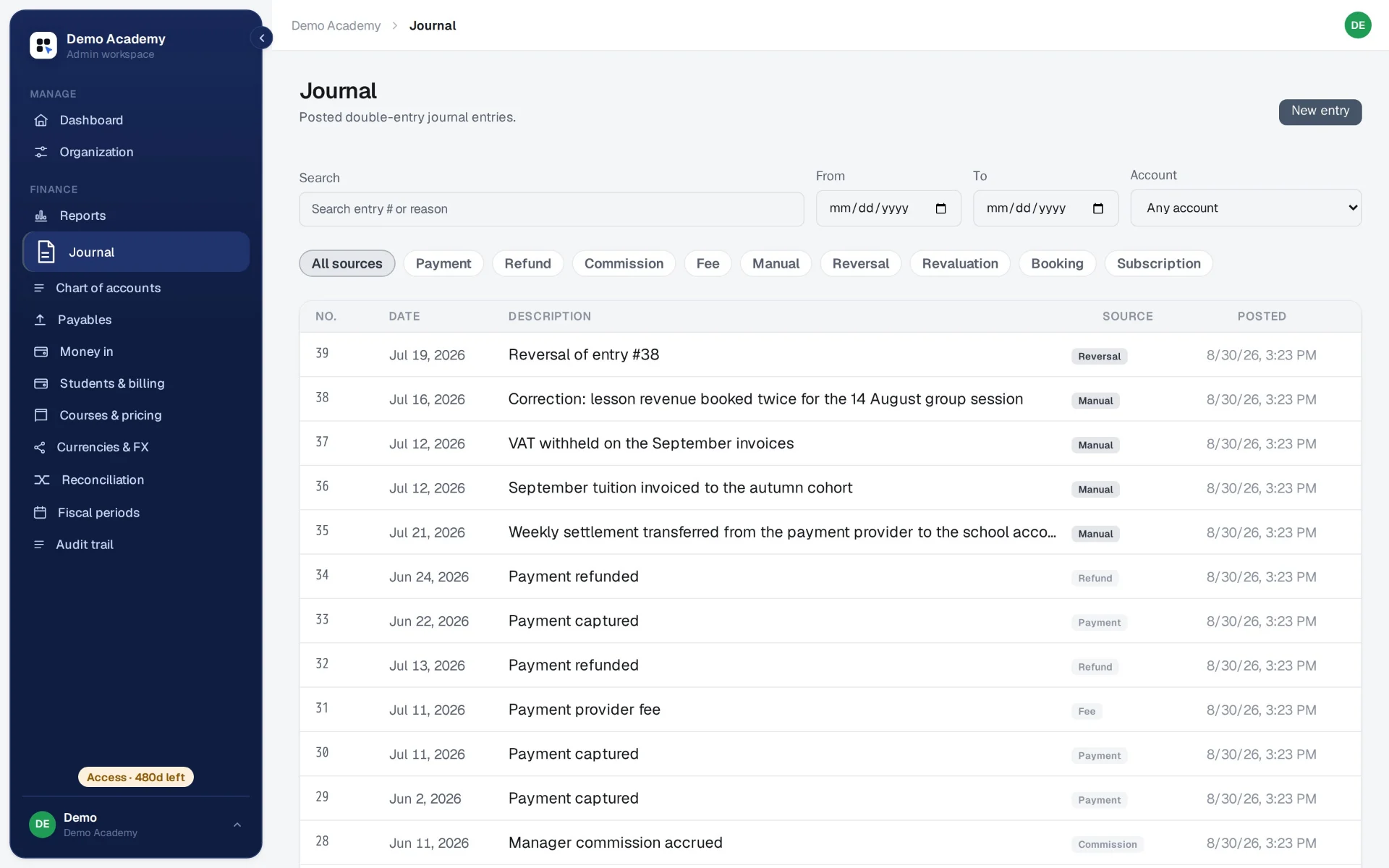
An example month in a school's own currency. One currency per school: a price in another is refused rather than quietly converted.
The rail stays yours. Card, an open-banking transfer or a QR payment runs through the school's own bank or provider - we integrate the one you already hold, so the money reaches your account and never passes through ours. What the workspace keeps is the record: what was charged, what arrived, what is still owed.
The question owners ask last and worry about first
The course stays with the school.
- Content belongs to the organisation, not to the person who typed it. A teacher leaves; the courses, tasks, boards and vocabulary decks do not leave with them.
- A new teacher starts from your material, not from their own. The same published course, the same tasks, the same standard in every group.
- One task is reused across courses instead of copied into each - so improving it improves every lesson that uses it.
- A course can be listed to other academies, if you build material worth selling. Your lessons, boards and private fields are never part of what they see.
- Roles are set per school, not fixed by the software: owner, administrator, bookkeeper, teacher.
- An employed teacher does not price anything. The Finance section is absent from their panel rather than refused on arrival - pricing is the operator's decision and the bookkeeper's record.
- Students never see answer keys, and during a live lesson the board shows totals only. The group sees how it is doing; nobody sees who got it wrong.
- Every action is checked against one permission, and an id from another school answers as if it did not exist.
| Role | Teaches | Names prices | Reads the books |
|---|---|---|---|
| Teacher | Yes | No | No |
| Administrator | No | Yes | Yes |
| Bookkeeper | No | Yes | Yes |
| Solo tutor | Yes | Yes | Yes |
White label
Your brand on the door. Ours nowhere.
Your school's sign-in page can live at your own address, in your colour, under your logo. A student joining your school joins your school - they are not asked to learn the name of a platform you chose.
- Your address. A verified domain of yours points at your workspace, and the door reads which school it is from the address it was opened at.
- Your colour and logo on the door, the tab icon and the panels - applied before the page appears, not after it has been seen in ours.
- One door, four rooms. Teacher, student, administrator and bookkeeper sign in at the same page and land where they belong.
- Nothing to install. Everything runs in a browser; the student and teacher panels can be added to a phone's home screen.
- Three languages today - English, Polish and Ukrainian - chosen by the person reading, not by the school's default.
- Invitations, not open sign-up. The school invites its staff, a teacher invites their students, and a student can pass a short code to a friend.
Said plainly
What this is not.
Not an AI grader
No model decides a student's result. AI drafts tasks for a teacher to edit, on the school's own key.
Not per seat
Nothing counts teachers, students or courses. There is no head-count limit anywhere in the product.
Not a video service
Bring your own call. A lesson carries the link; the board does the rest.
Not a crypto product
No crypto rail and no identity-verification surface. Both were removed from the product deliberately.
Before you ask
Questions schools ask.
How long does it take to move a school in?
The people and the schedule move in a day; the material takes as long as your material takes. We start a demo on one real course of yours rather than a sample, so what you are looking at is the effort, not a guess about it.
Do teachers have to be retrained?
A teacher opens one board per course and teaches on it. The parts they usually resist - a second tool for homework, a third for marking - are the parts that go away.
Which currency do the books work in?
Your school's own. Plans, course prices, student accounts and every figure are kept in it, and a price in another currency is refused rather than converted behind your back.
Can our own accountant work in it?
Yes - the bookkeeper is a role of its own, with the ledger, the statements, period close and bank reconciliation, and no ability to change what is taught.
Who owns the data?
The school. Every record is scoped to your organisation, an id from another school answers as if it did not exist, and the reports export.
What will it cost?
We are still setting the plans for launch, so we will not print a figure here that we might have to take back - ask at the demo and we will tell you where it stands. One thing is already settled by how the product is built: nothing counts heads. There is no per-teacher, per-student or per-course limit anywhere in it, so growing does not quietly reprice you.
Bring one of your courses.
We set the demo up on your material, your prices and your currency - so the hour you spend on it tells you something about your school rather than about our sample data.