For tutors who teach on their own
A school of one, with your name on the door.
You teach. EdTechCore holds the lesson, the homework, the schedule and the account - and your students sign in at an address that carries your name, not ours.
We are launching by invitation. Tell us what you teach, and we set the workspace up with you.
Where the week goes
The hours nobody pays you for.
A tutor's income is hours times a rate, and the ceiling arrives quickly. What decides the year is not the rate. It is how many unpaid hours sit around every paid one.
Rebuilding materials
Every course starts from an empty page, and last year's tasks are in a folder you no longer trust.
Write a task once and reuse it in another course. Take a batch drafted by AI on your own API key and edit it, or build it by hand in the constructor. Vocabulary decks feed flash tasks, board widgets and spaced repetition from the same words.
Setting the lesson up
A call, a screen share, a slide deck, and a file each student opens somewhere else.
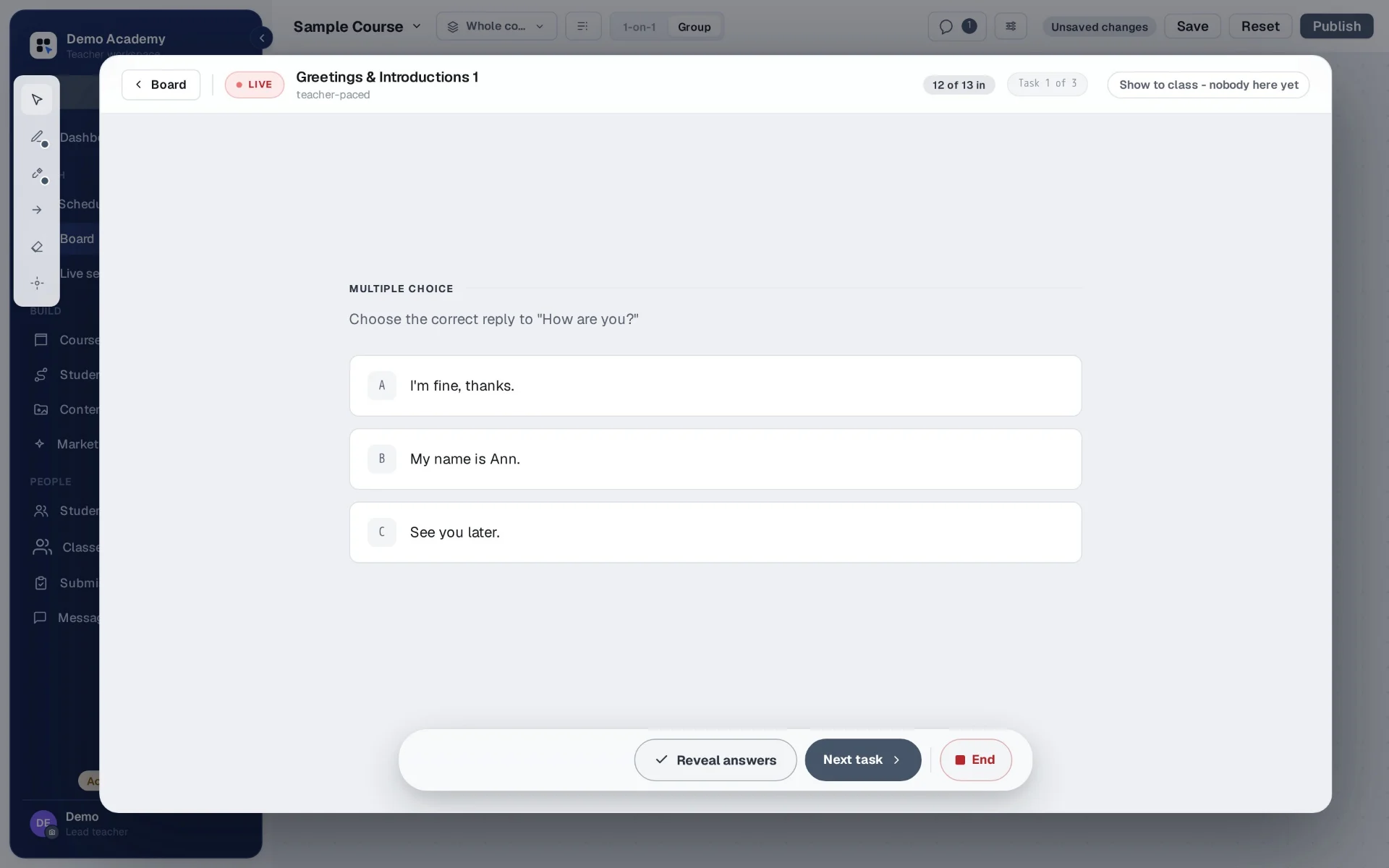
The whole course lives on one canvas: modules, lessons, tasks and media on one surface everyone sees at once. Save keeps a draft, publish shows it to students, reset returns to the published version. Drawing on top is ink - live, and never saved over your content.
Marking closed tasks
The same evening, every week, on answers that have exactly one right result.
Closed task types are marked by the engine the moment the student answers. The same answer gets the same result every time, with no charge per answer and no waiting for a model.
Writing what to fix
Typed twice for two students who made the same mistake, and read once.
Attempts, grades and mistakes are held per lesson. The student has a Mistakes screen that replays what went wrong, and a review queue that brings it back before it is forgotten.
Asking to be paid
The message you put off sending, then send twice, then stop sending.
Each student has an account you read one month at a time: what was charged, what arrived, what is carried over, what is still owed. Access follows payment, so the reminder is the product rather than a message you have to write.
Looking like a business
A personal meeting link, a shared document, and a first impression you did not design.
Your students sign in at your own address, in your colour, under your name - and can put it on the home screen of a phone as an app.
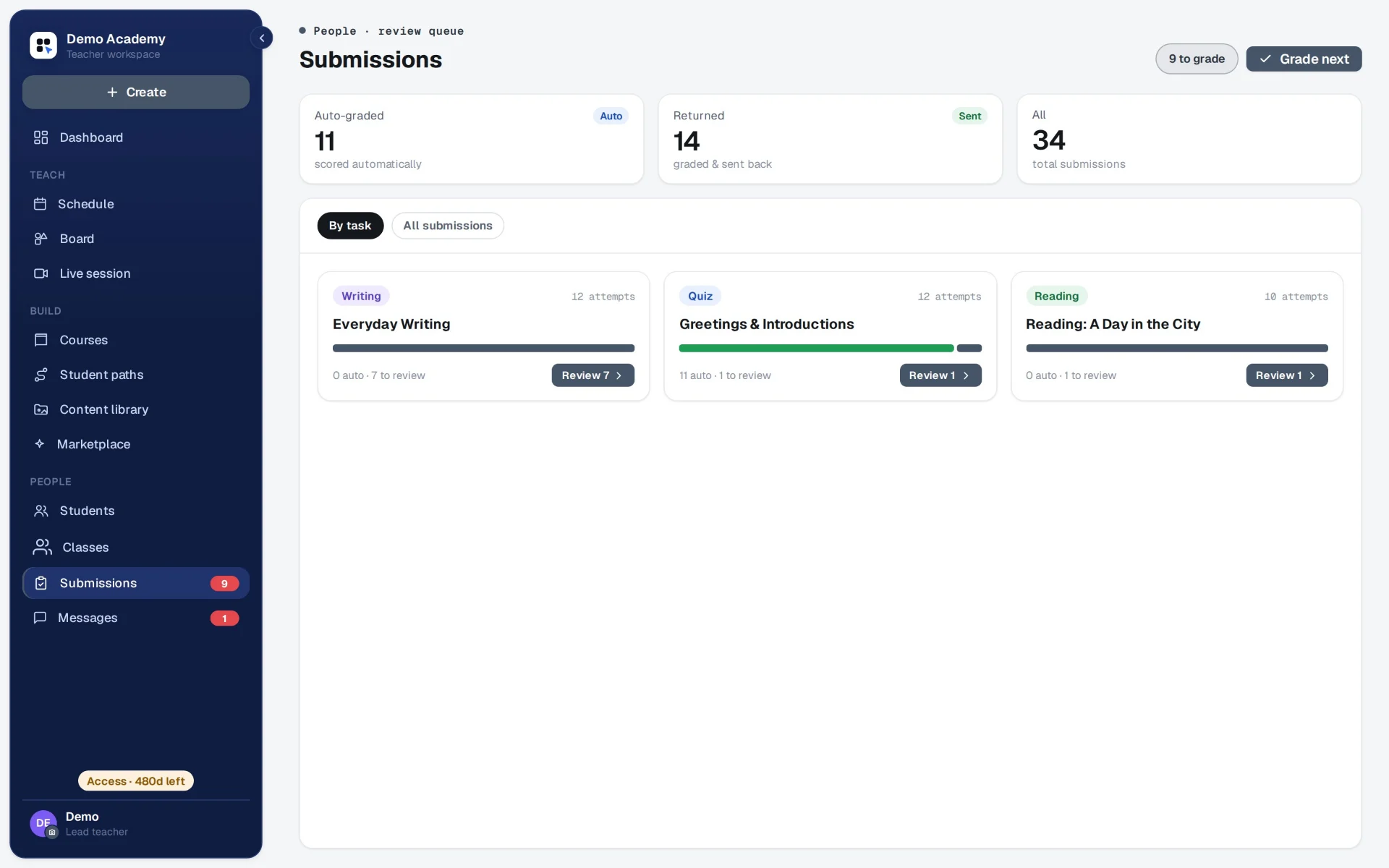
Open-ended answers still come to you. Writing, speaking and anything that needs judgement is marked by the teacher - that is the part worth paying a teacher for, and the part we refuse to fake.
Standing, not decoration
Your name on the door.
A student who books lessons with you should not have to sign in to a brand they never chose. Your workspace can have its own address, its own colour and its own logo, and the sign-in page opens in them before it opens in ours.
An illustration of the branded sign-in, not a screenshot - the colour, the name and the logo are set per workspace.
- Your own address. A subdomain of ours today, your own domain when you have one. The link you put in a bio and hand to a parent.
- Your colour and logo on the door, on the tab icon and inside the panels your students use.
- A one-page site beside it if you want one - your languages, your levels, and a form that reaches you.
- One sign-in, three workspaces. You, your students and - if you ever hire - an administrator, each opening the same door into a different room.
- Nothing to install. It runs in the browser and can be added to a phone's home screen as an app.
Money
You name the price. The account keeps itself.
Teaching for yourself means there is no administrator to hand the numbers to. So the numbers are part of the product: you set what a course costs, what a student pays, and the workspace keeps the running account underneath.
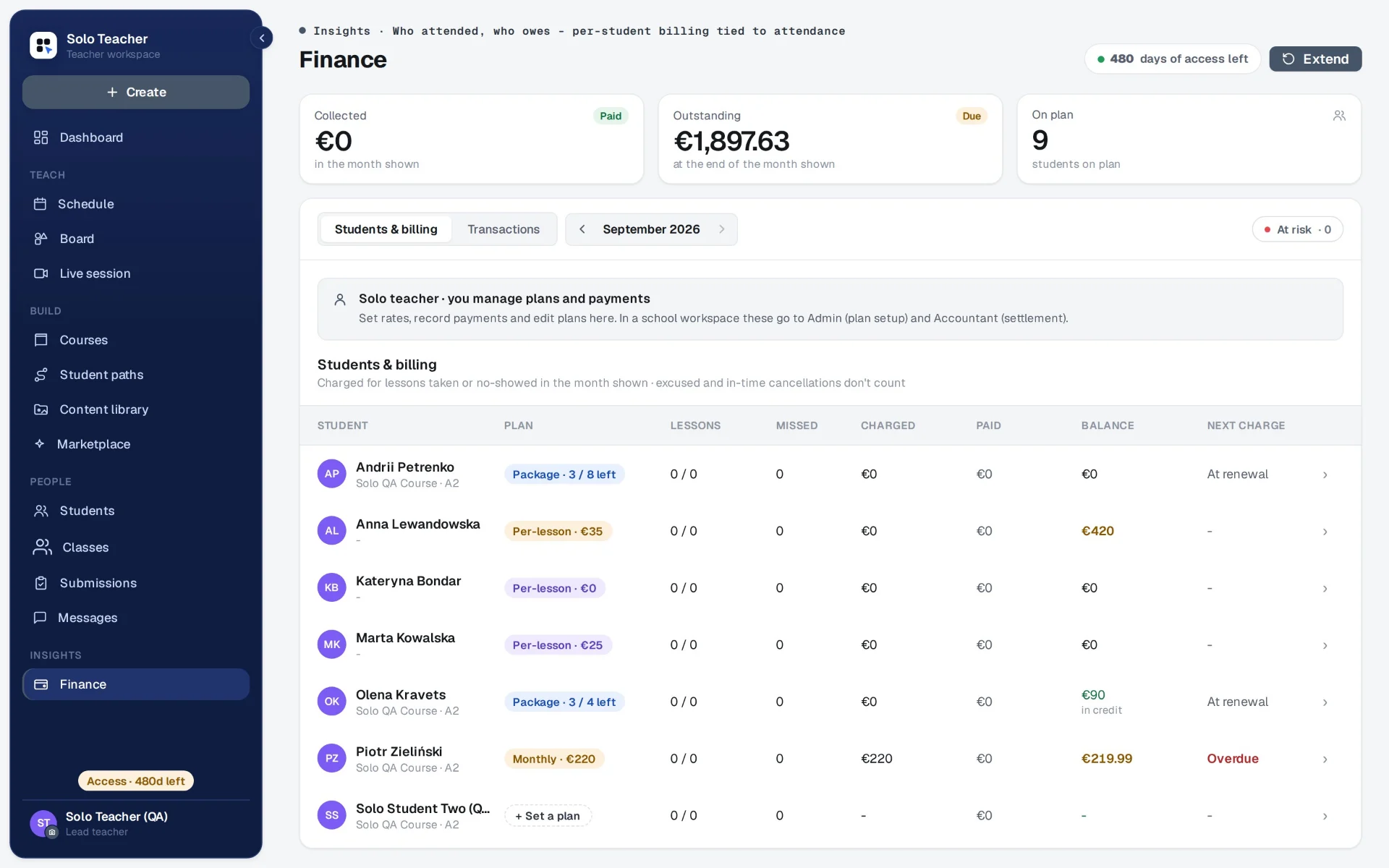
- One currency for your workspace. Course prices, student plans and every figure you read are in it; a price in another currency is refused rather than quietly converted.
- A month is an account, not a snapshot. What was not paid in September is brought forward into October instead of disappearing at the boundary.
- Access follows payment. A paid period is a dated window. When it runs out, the workspace stops rather than a reminder being sent.
- The rail is your bank, not ours. Card, an open-banking transfer or a QR payment - we connect the provider you already have, so the money goes to your account and never through ours. What lands here is the record: charged, paid, brought forward.
- Students can book you. Publish lesson types and the times you are free; a student picks one and it lands in both schedules.
Where AI stops
AI drafts. It never grades.
It writes the first draft
Ask for a batch of tasks on a topic and level, then edit what comes back. It saves the blank page, not the teaching.
It runs on your key
You connect your own API key, so the cost of drafting is yours, visible, and stops when you stop asking.
It does not mark work
Closed types are marked by a deterministic engine - the same answer, the same result, every time. Open answers are marked by you.
Students keep their answers
Answer keys are never sent to a student's browser, and during a live lesson the board shows totals only. Nobody sees who answered what.
Said plainly
What this is not.
Not an AI grader
No model decides a student's result. Ever.
Not a video service
Bring your own call. The lesson carries the link; the board does the rest.
Not a marketplace you compete on
Your students are yours. We do not rank you against other tutors.
Not four subscriptions
The board, the tasks, the homework and the account are one system.
Before you ask
Questions tutors ask.
Do I still need Zoom or Google Meet?
For the video, yes - we do not host video calls. A lesson carries its meeting link, so the call and the board open together. Everything else the lesson needs is here.
What does a student have to install?
Nothing. Everything runs in the browser, and both the student and the teacher side can be added to a phone's home screen as an app.
Can I move my existing materials in?
You rebuild them as tasks rather than importing a folder - and once a task exists it is reused across courses instead of copied. Ask us at the demo what your material looks like in the constructor; that is the fastest way to find out.
Who marks the work?
Closed task types are marked by the engine, instantly. Writing, speaking and anything open is marked by you, in a grading view that shows the attempt beside the answer.
How do my students pay me?
Through your own bank or payment provider. We connect the rail you already use - card, open banking or a QR transfer - so the money reaches your account directly, and the payment settles that student's month here. Setting it up is done with you rather than by flipping a switch, and a payment recorded by hand works the same way for anyone who would rather keep it simple.
Do my students see the platform's name?
They see the name and the colour you set. The sign-in page, the tab icon and the panels carry your brand.
What will it cost?
We are still setting the plans for launch, so we will not put a figure on this page that we might have to take back. Ask at the demo and we will tell you exactly where it stands. One thing is already settled by how the product is built: nothing counts heads. There is no per-student, per-teacher or per-course limit anywhere in it.
How do I get an account?
By invitation while we launch. Ask for a demo, we set the workspace up with you, and you invite your students with a link or a short code.
Show us what you teach.
We will set up a workspace on your own materials and your own prices, so what you look at is your teaching, not a demo account with somebody else's course in it.