Schedule
One week, and it answers for itself.
One-to-ones, groups, a whole course at once, your own time blocked off, and the hours you leave open for booking. What you mark in the week is what a student's calendar shows and what their account owes.
The same schedule the lesson opens from, so nothing is kept in two places.
What a week holds.
A lesson, given to the people it is for
One student, a group, or everybody on the course. The lesson carries its audience, so nobody is added by hand twice and a group that changes does not leave an old list behind.
Your own time, blocked off
An hour you are not free is a thing in the week rather than a thing you remember. That is what makes a free hour free on purpose.
The hours you leave open
Marked bookable, they are the only times a student can take, and each one stops being offered the moment it is taken.
A lesson moves, and the move travels.
Drag it to its new hour. A subscribed calendar is told properly: the same lesson moves there instead of turning up twice, and a lesson called off is taken off the week rather than left sitting in it. A student's own entry names the lesson, never the other students in it.
In the calendar you already keep.
The schedule gives you a private link that Google, Apple and Outlook all read, so teaching sits beside the rest of your week without being typed in again. A student has the same link for their own lessons. It runs one way, which is the honest half of it: what you write in your own calendar stays there.
The open hours book themselves.
A student takes one of the times you left open, from their own schedule or from the catalogue of lesson types in your school. A free time is booked outright, a priced one holds until the payment clears, and either way the hour stops being offered to anybody else.
The register is the bill.
Mark who came, and the money follows without a second act of bookkeeping. Each student is on a plan - by the lesson, a package, or a month - and it is counted against the attendance you recorded: present, late and a missed lesson are billable, an excused one is not. What a student owes is a live figure rather than something waiting for somebody to post it.
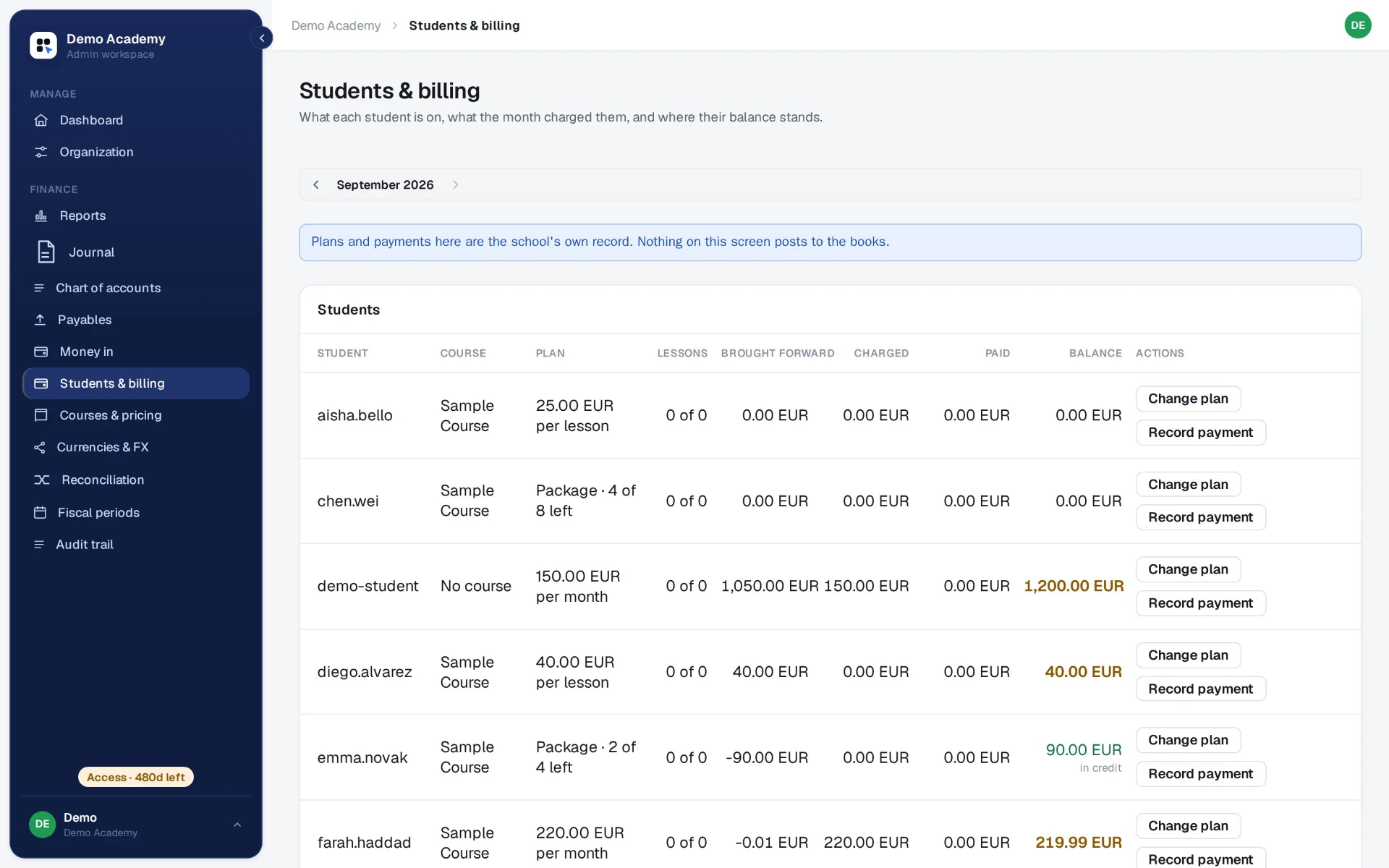
That is the teacher's view of who owes what. The school's double-entry books are a system of their own, and the bookkeeper works there.
Show us a week of your timetable.
Your lessons, your groups, your prices. We set the week up with you, so what you are judging is your own timetable rather than a demo account's.